
Replace one or more missing teeth with treatment planned according to the condition of your bone, gums, and oral health.
In Clínica Dental Champsaur we carry out evaluation and treatment with dental implants in Panama under the care of Dr. Angela María Prieto, specialist in Periodontics, with practice aimed at bone regeneration and dental implants.
Planning includes clinical evaluation, X-rays, and CBCT scan to determine whether the implant is an appropriate alternative and to set the necessary stages for each patient.
The implant and crown are different components of the treatment. The final cost depends on the diagnosis and the necessary procedures in each case.

Replace missing teeth naturally.
Greater stability and comfort while eating.
It maintains stimulation in the area of the missing tooth.
Designed to integrate into your daily life.
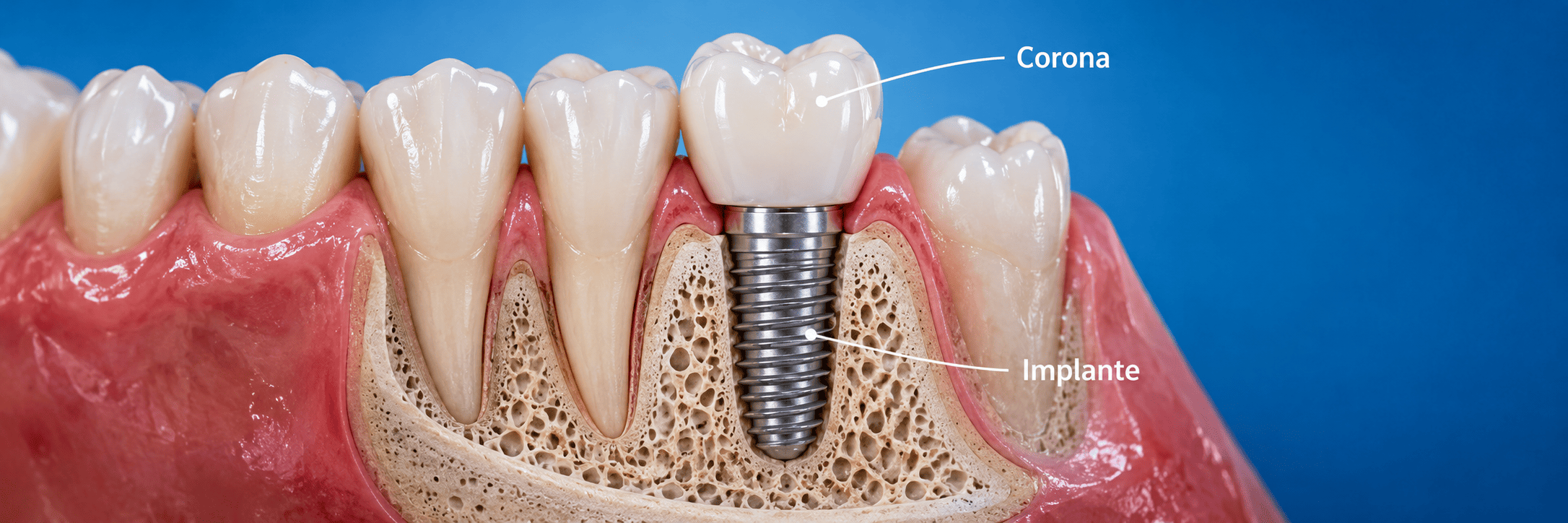
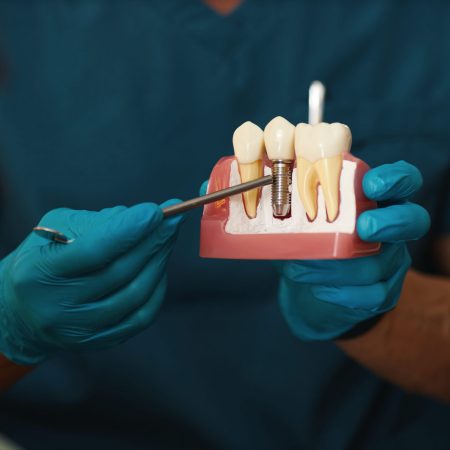
A dental implant is a device that is surgically placed into the jaw bone or jaw to create support for a restoration that replaces one or more missing teeth.
The implant replaces the support function of the lost dental root. The restoration phase is then performed to place the visible part of the tooth.
Implants can be used to:
The indication should always be established after an evaluation, as an implant is one of several possible alternatives to replace a lost tooth.
An implant evaluation may be indicated when:
The decision does not depend solely on the space where the tooth is missing. Bone, gums, bite, general health and restorative possibilities should also be evaluated.
No.
The dental implant is the component that is placed inside the bone and functions as a support.
The crown is the visible restoration that is subsequently connected to the implant to replace the tooth.
Simplified form:
Implant → prosthetic component → crown
For this reason, implant placement and final restoration correspond to different phases and components of treatment.
Not all patients initially present the same conditions for receiving an implant.
Before recommending treatment, we evaluate factors such as:
In some cases procedures may be necessary before placing the implant to improve the conditions of the area.
It may be possible, but periodontal disease should be treated and stable before surgery.
History of periodontitis is also important during subsequent maintenance, as it may increase the risk of problems in the tissues surrounding the implants.
Treatment begins with a complete diagnosis.
The first consultation aims to determine whether the implant is an appropriate alternative and what conditions should be resolved before placing it.
The evaluation may include:
For implant planning we use radiographic studies and CBCT scan when indicated.
The three-dimensional information on the CBCT scan can be evaluated:
Planning is an essential part of the treatment and allows defining the specific characteristics of each case before performing surgery.
Each treatment may have different stages and times.
Generally speaking, the process may include:
The conditions of the missing tooth, gums, bone, existing teeth and patient needs are reviewed. The images needed to establish the treatment plan are also analysed.
It is determined:
• If the implant is indicated.
• Conditions of the bone.
• Gum status.
• Right position.
• Need for prior treatments.
• Need for bone regeneration.
• Restoration planned later.
The implant is surgically placed inside the bone in the previously planned position.
In Clínica Dental Champsaur, titanium implants and titanium alloys are used with surface treatment.
Conventional surgery can be performed using local anesthesia.
After placement a period of healing begins during which osteointegration occurs, that is, the integration of the implant with the bone.
As a general reference, in many conventional treatments this stage may take approximately 2 to 6 months.
Real time may vary according to:.
• Area treated
• Quantity and quality of bone.
• Initial stability of the implant.
• Need for bone regeneration.
• Type of procedure.
• Individual response.
Once the implant is ready for restoration, the prosthetic phase is coordinated.
A crown may be placed on the implant in an individual dental replacement.
The restoration is planned according to the clinical and functional characteristics of each patient.
When a single tooth is missing, an implant can be used as a support to replace it.
Treatment usually includes:
Implant + prosthetic component + crown
One of the advantages of this alternative is that, in certain cases, it allows replacing the lost tooth without necessarily using neighboring teeth as a support.
The possibility depends on the available space, bone, gums, bite and state of the nearby teeth.
When several consecutive teeth are missing, several strategically distributed implants can be used to create support in the area.
It is not necessarily necessary to place an implant for each missing tooth.
The number and position of implants are determined individually according to:
Having little bone doesn’t automatically mean you can’t get an implant.
We must first determine how much bone exists, where the deficiency is found, and whether appropriate conditions can be created for treatment.
Where the existing bone volume does not allow an implant to be placed in an appropriate position, bone regeneration procedures may be considered.
These procedures seek to improve certain areas of bone before or, in selected cases, along with implant placement.
The need for regeneration depends on the diagnosis.
Dr. Angela María Prieto specifically directs her practice to Periodontics, bone regeneration and dental implants, which allows the joint evaluation of the condition of the gums and bone around the area to be treated.
In certain posterior areas of the upper jaw there may be little bone due to the proximity of the maxillary sinus.
Some patients may need breast elevation or augmentation to create adequate conditions for implant placement.
Not all upper implants require this procedure.
The price of an implant treatment depends on its particular characteristics.
It is important to differentiate both components:
The implant is placed inside the bone.
The crown is the visible restoration that is subsequently connected to the implant.
The final cost may vary according to:

Number of implants.
Case complexity.
Necessary studies.
Conditions of the bone.
Need for bone regeneration.
Additional procedures.
Conventional placement of an implant can be performed using local anesthesia.
Clínica Dental Champsaur also has oral and intravenous sedation options for certain patients and procedures.
Sedation can be evaluated, for example, in patients with dental anxiety or when the characteristics of the procedure make it convenient.
Not all patients need sedation.
Their indication is determined individually during the evaluation.
No todos los pacientes necesitan sedación.
Su indicación se determina individualmente durante la evaluación.
After surgery may appear temporarily:
The intensity and duration may vary according to:
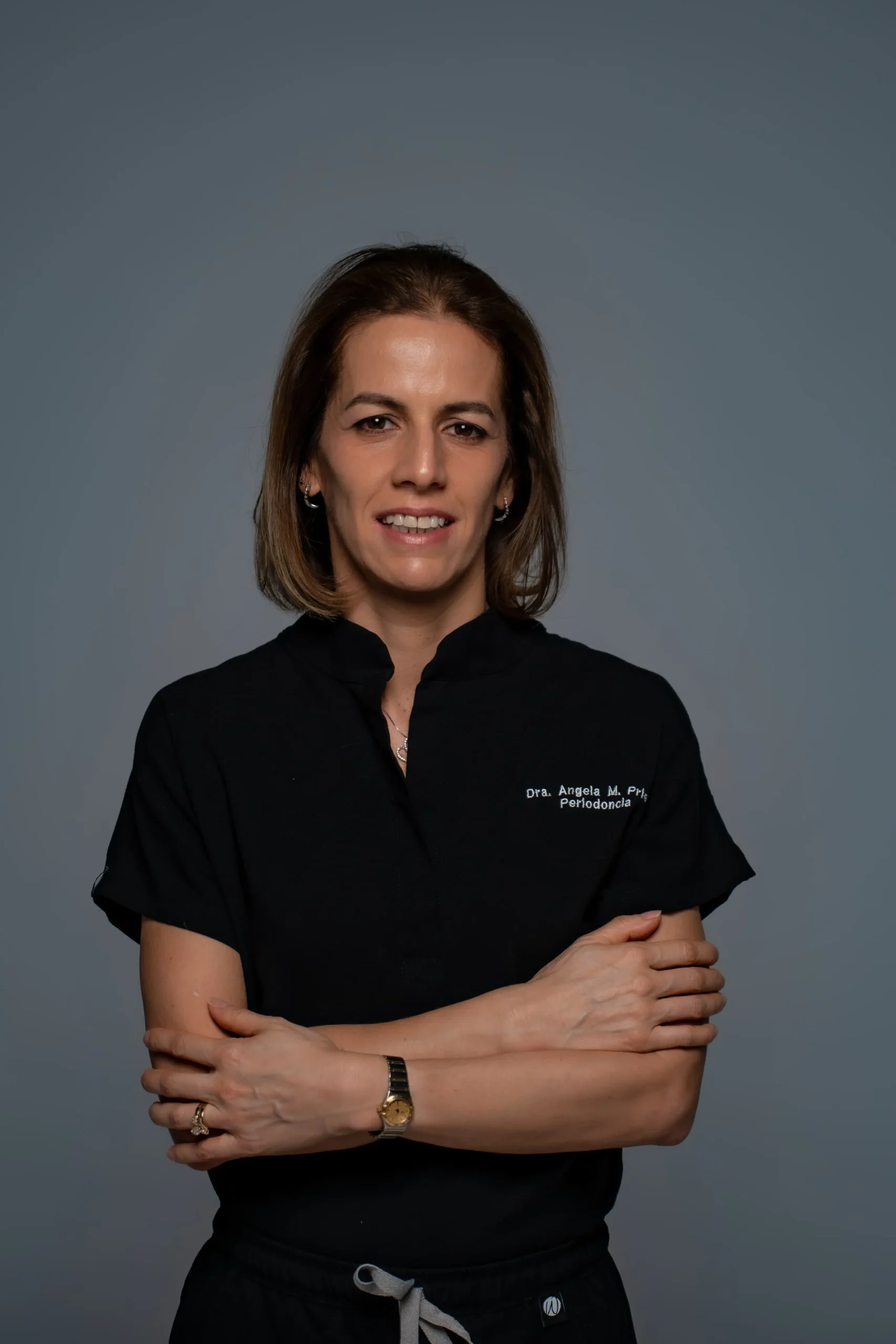
Dental implant treatments at Clínica Dental Champsaur are attended by Dr. Angela María Prieto.
Dr. Prieto has been a dentist at the Pontificia Universidad Javeriana de Bogotá, Colombia, since 1997 and a specialist in Periodontics at the same university since 2002.
Its practice is specifically aimed at:
He is a member of the Panamanian Dental Association and has additional training through national and international courses.
This training allows to approach the planning of the implant considering not only the space where the tooth is missing, but also the condition of the tissues that will support it.
ición de los tejidos que lo sostendrán.

Si perdió uno o varios dientes, el primer paso es determinar si los implantes son una alternativa adecuada para su caso.
Durante la evaluación revisaremos las condiciones de sus encías, hueso y zona a tratar y analizaremos los estudios necesarios para establecer un plan individualizado.
Agenda una evaluación con la Dra. Ángela María Prieto en Clínica Dental Champsaur.
It is a device that is surgically placed inside the bone to create support for a restoration that replaces one or more missing teeth.
No.
The implant is placed inside the bone and functions as a support.
The crown is the visible restoration that is subsequently connected to the implant.
They are different components of treatment.
The implant treatments are attended by Dr. Angela María Prieto, specialist in Periodontics, whose practice is aimed at Periodontics, bone regeneration and dental implants.
An evaluation is necessary.
The general health, gums, bone, hygiene, bite and conditions of the area where the implant will be placed should be reviewed.
Some patients need additional treatments before surgery.
In certain cases, yes.
A bone regeneration procedure may be necessary to improve the condition of the area.
The possibility depends on the amount, location and characteristics of the bone available.
No.
Bone regeneration is indicated only when bone conditions require it.
Tomography and clinical evaluation make it possible to determine whether there is enough bone or whether additional procedures are needed.
Surgery can be done using local anesthesia.
Post-procedure discomfort, swelling, or temporary tenderness may occur.
The intensity depends on the treatment performed and the individual response.
Yes, in certain cases.
Dental Clinic Champsaur offers oral and intravenous sedation options for selected patients and procedures.
The indication should be established after assessment of the case.
As a general reference, many conventional treatments contemplate approximately 2 to 6 months for the stage of osteointegration.
The time may be shorter or longer depending on the bone, location, procedure, and individual response.
An implant is not necessarily placed for each lost tooth.
The amount depends on the space, available bone, anatomy, bite and restorative planning.
Smoking does not automatically mean that it is impossible to place an implant, but it is a risk factor that can affect healing and long-term results.
It should be assessed individually during planning.
It may be possible depending on your general condition and disease control.
Diabetes should be considered as part of the medical evaluation because it can influence the risk of complications.
It can’t be guaranteed.
Implants can work for many years, but their longevity depends on factors such as:
The final cost depends on diagnosis, studies, number of implants, bone conditions, need for bone regeneration and other procedures that may be necessary.
If you lost one or more teeth, the first step is to determine if implants are a suitable alternative for you.
During the evaluation we will review the conditions of your gums, bone and area to be treated and analyze the studies necessary to establish an individualized plan.

